
Photovoltaics on roofs & canopies
Rooftop arrays, parking-lot canopies and shading pergolas deliver peak-hour electricity for pumps, lighting and HVAC — the parts of the load that track daylight.
The wellness sector is growing — pool energy costs are growing faster. Here is a blueprint for a large-scale thermal aquapark that powers itself from a hybrid of renewables — photovoltaics, geothermal, wind and a hydrogen buffer. Built to be replicated in every region with a geothermal resource, from Poland and Germany to Hungary, Turkey and Iceland.
A thermal aquapark is one of the most energy-hungry buildings in any city. It is also, by geography, one of the most likely to sit above a geothermal resource. There is no good reason why such a facility should not generate most of the energy it consumes — on site, from the ground beneath it.Wolfgang Beick · President, ITC Europe
Thermal aquaparks and wellness resorts are one of the fastest-growing segments of European tourism. They are also, structurally, one of the heaviest energy consumers in the built environment: pool heating, ventilation, hot water, spa treatments and lighting run around the clock. Annual energy bills for a mid-size facility frequently reach 1–3 million euros.
At the same time, geothermal resources are widely available and still largely untapped across Central and Southern Europe. Combined with rooftop PV, a small on-site wind footprint and a hydrogen buffer for peak loads, a thermal aquapark can flip from a high-OPEX cost center to an energy-positive destination.
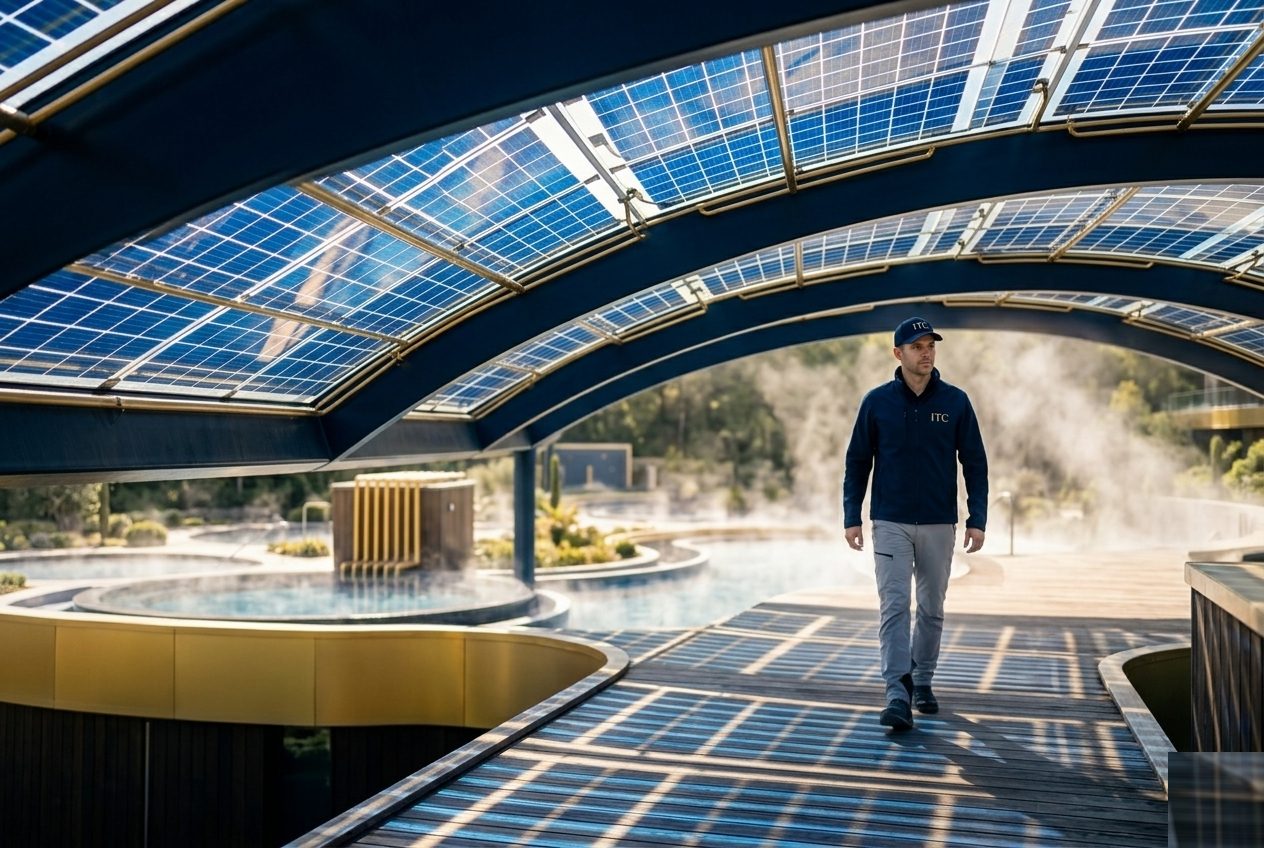
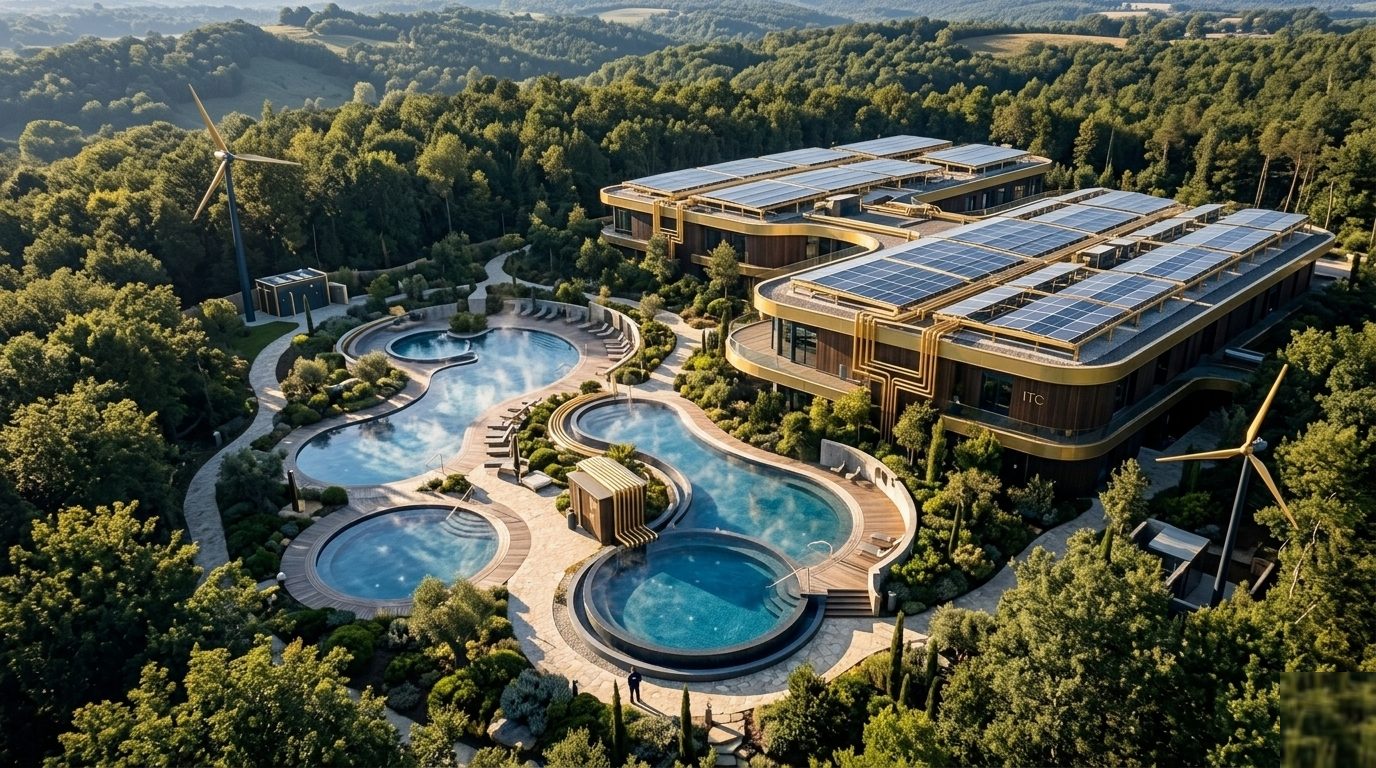
Pools, wellness, hotel, catering — every sub-programme runs off the same integrated PV, geothermal, wind and hydrogen stack. Peaks are absorbed on site, not bought at spot price.
Each element of the stack covers a different part of the demand curve — together they deliver a near energy-positive operation. None of this is experimental technology; the novelty is in integrating all four in a single facility.
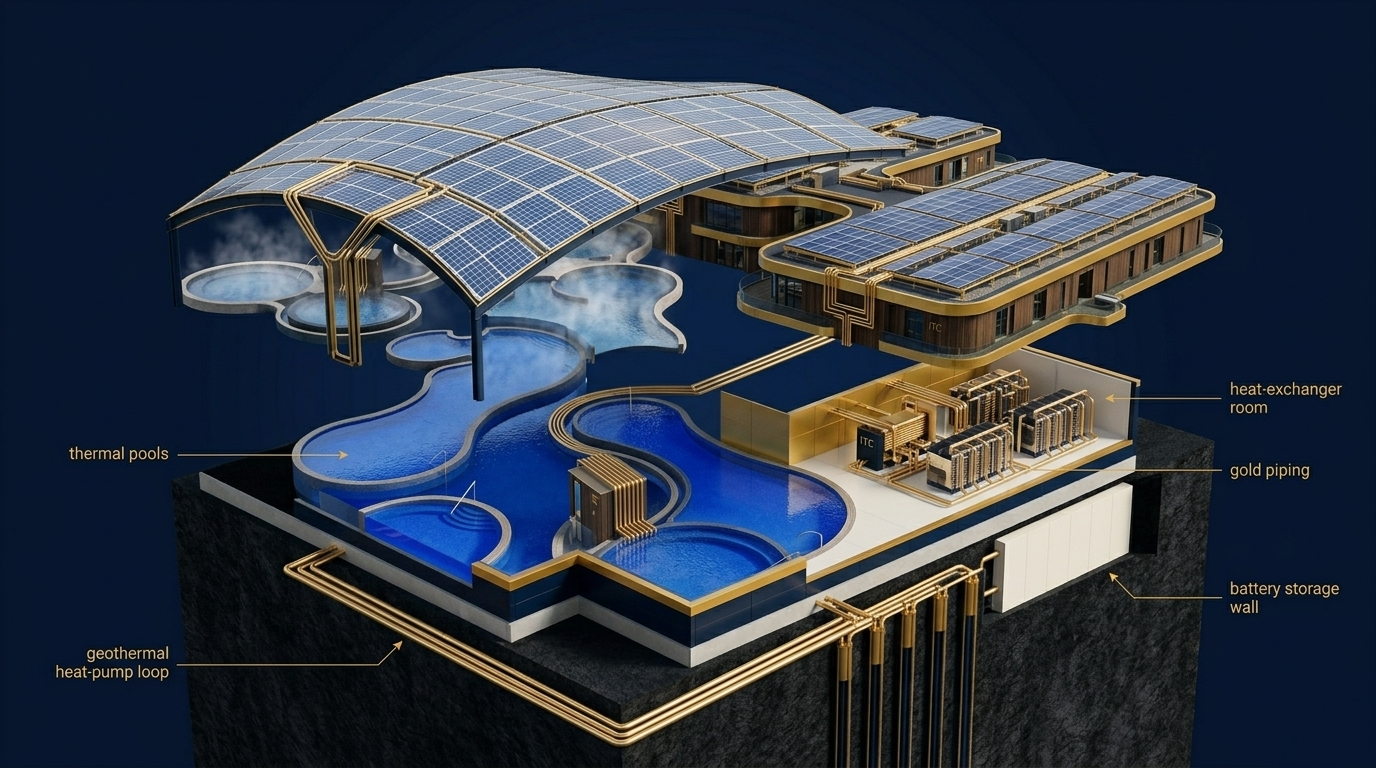
Rooftop arrays, parking-lot canopies and shading pergolas deliver peak-hour electricity for pumps, lighting and HVAC — the parts of the load that track daylight.
Where the resource allows, direct-use geothermal heats the pools and the wellness zone year-round. Where it does not, large geothermal heat pumps (COP 4–5) take over.
A small wind footprint (1–3 turbines) plus a battery system smooths the PV profile, covers night operation and acts as the resilience layer for critical loads.
Surplus summer PV is converted into hydrogen and stored on site. A small fuel-cell plant returns power during winter peaks and cold snaps — closing the last 20–40% of the demand.
Indicative envelopes for the three typical deployments. Real numbers depend on irradiation, the quality of the geothermal resource and local wind conditions.
| Scale | Water surface | Annual energy demand | Self-sufficiency target | Typical context |
|---|---|---|---|---|
| A · Wellness hotel | 500 – 2,000 m² | 2 – 6 GWh/yr | 50 – 65% | 4–5★ resort, shallow geothermal + PV |
| B · Municipal aquapark | 2,000 – 8,000 m² | 6 – 18 GWh/yr | 60 – 75% | Public facility, deep geothermal + PV + battery |
| C · Thermal destination | 8,000 – 20,000 m²+ | 18 – 45 GWh/yr | 70 – 85% | Integrated resort, full PV + geo + wind + H₂ |
Public spa operators, wellness hotel groups and resort developers ready to build — or retrofit — with an energy-first mandate.
Geothermal developers, drilling contractors and geological services willing to co-develop sites where the resource is well-documented.
Technology providers for PV, small wind, batteries, electrolysers and fuel-cell systems — the four layers of the energy stack.
Tourism funds, regional banks, green-transition programmes and infrastructure investors co-financing the long-payback parts of the project.
Module layouts designed to double as weather shading, paired with a geothermal well field sized to the pools. Peaks covered by wind and H₂.
A 30-minute conversation to see if the site, scope and timeline fit your organisation.
We map the geothermal resource, the irradiation, the wind profile and the demand curve of your facility or site.
A bounded study (3–6 months) producing the numbers for an investment decision or a public funding bid.
If the pre-feasibility lands, partners form a consortium to carry engineering, permitting and financing.
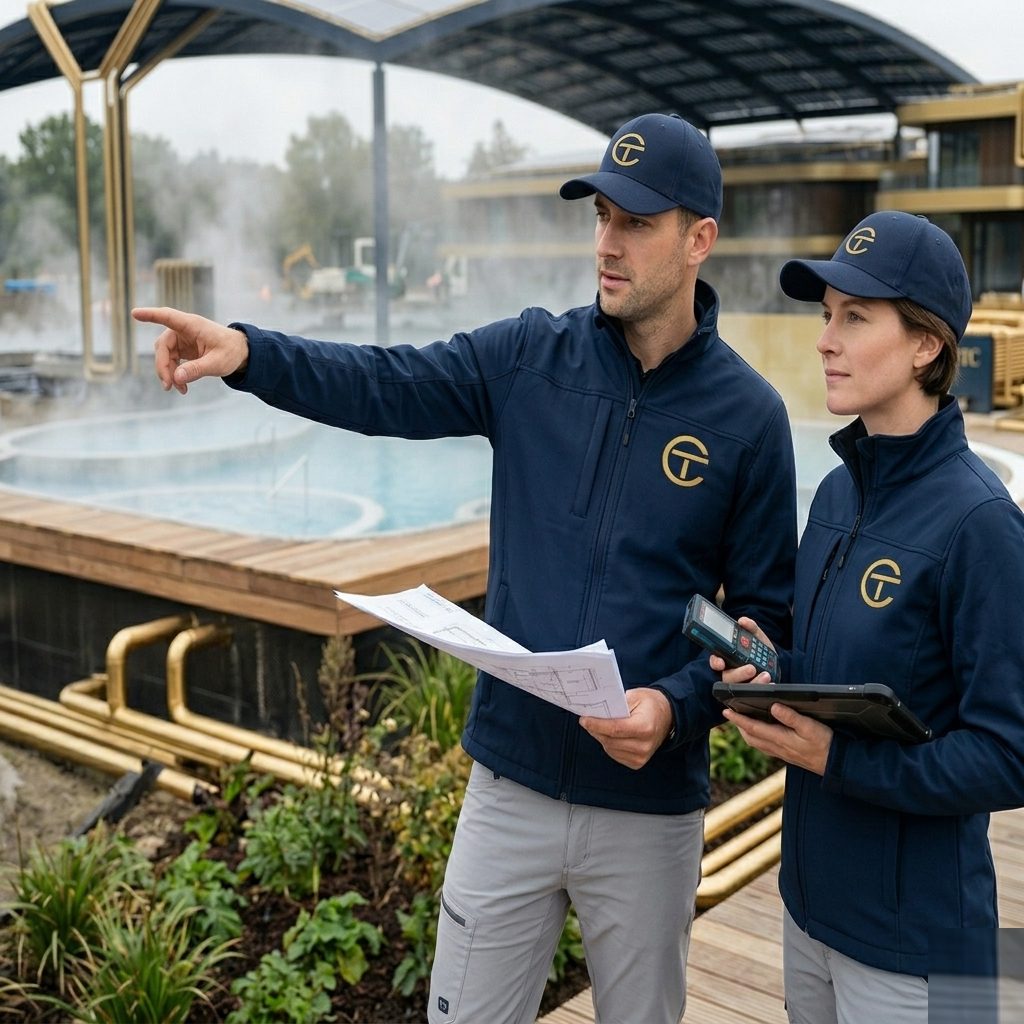
Conversations with municipalities, resort operators and geothermal developers are being set up — partners can plug in now.
We treat every serious message as a conversation, not a pitch. Tell us briefly who you represent and what part of the programme you are curious about — we will come back with a short, specific reply.
Working languages: English · German · Polish.